Bonds Now Out-Yield ASX Shares
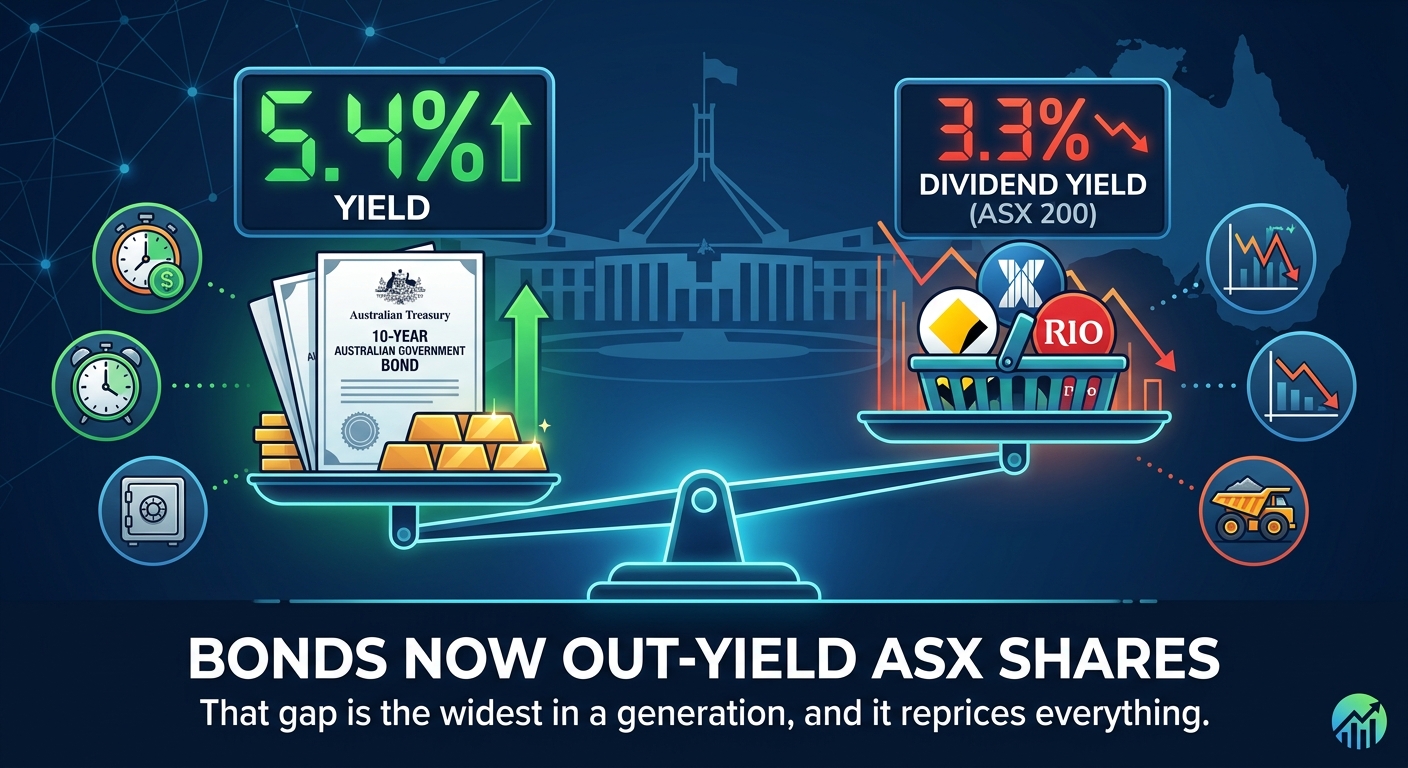
- A 10-year Australian government bond now pays 5.4%. The ASX 200 yields about 3.3% in dividends
- That gap is the widest in a generation, and it reprices everything
- Franking changes the maths but not by as much as most people assume
For about fifteen years, Australian investors lived under an acronym: TINA. There Is No Alternative.
Cash paid nothing. Term deposits paid slightly less than nothing once you allowed for inflation. Bonds were a rounding error. If you wanted income, you bought shares, because there was genuinely nowhere else to go.
An entire generation built portfolios on that assumption. Retirees loaded up on bank shares for the dividends. SMSFs went heavy on Australian equities because the alternative was watching cash go backwards.
That era is over, and it ended without much fanfare.
The Australian 10-year government bond is now yielding above 5.4%, its highest since May 2011. The ASX 200’s trailing dividend yield is sitting around 3.3%.

Read that again. The government will pay you more, guaranteed, for a decade, than the sharemarket is currently paying in dividends.
There is now an alternative. And the consequences are still working their way through.
How upside down is it?
Properly upside down.
Morningstar ran the numbers on a basket of 17 large-cap ASX names known as reliable dividend payers, collectively about 45% of the index. Back in 2019 that basket yielded 5.9% against a 10-year bond at 2.5%.
Shares paid you 3.4 percentage points more than government debt. That’s how it’s supposed to work: more risk, more return.
By early this year the same basket was yielding 4.1% against a bond at 4.8%. Upside down. And the bond has kept climbing since.
Two things happened at once. Bond yields went up, obviously. But ASX dividend yields also went down: the index long-run average is 4% to 4.5%, and we’re a full percentage point under it.
Why? Mostly the two blocks that dominate the index. Rio Tinto (ASX:RIO) declared its smallest dividend in seven years in February as costs rose and commodity prices sagged. And CBA (ASX:CBA) is yielding around 2.73% — not because the dividend shrank, but because the share price ran so hard the yield got squashed.
The uncomfortable bit: dividend growth across those reliable payers has been running at roughly zero. So it’s not low yield today in exchange for growth tomorrow. It’s low yield and not much growth.
The franking wrinkle
Right, before every Australian reading this fires off the obvious objection: what about franking credits?
Fair. It’s the genuinely Australian part of this and most international coverage ignores it entirely.
Bond interest is fully taxable. A fully franked dividend comes with a credit for company tax already paid, so you gross it up. A 5% fully franked dividend is worth about 7.1% before tax to an investor on a 30% rate. That’s a real advantage and it’s not small.
BUT run it at the index level.
The ASX 200’s 3.3% grossed up, assuming full franking, comes to roughly 4.7%. Still short of 5.4%.
Go to the high-yield end and it flips: 4.1% fully franked grosses to about 5.9%, which does beat the bond. So franking doesn’t rescue the broad index. It rescues a specific slice of it. And that slice is concentrated in exactly the banks-and-miners blocks we’ve written about before.
Two other catches. Not every dividend is fully franked; miners in particular are often partial. And franking is only worth something if you can use it. The benefit is biggest for a zero-tax pension-phase SMSF and smallest for an investor whose marginal rate is already low.
What a high long yield actually does to share prices
This is the mechanism worth understanding, because it explains moves that otherwise look random.
The cash rate sets what banks pay each other overnight. The 10-year sets, roughly, the rate at which the market discounts everything else.
When that discount rate rises, the present value of earnings arriving years from now falls. Mechanically. Whether or not the company has put a foot wrong.
It’s why tech was the worst-performing sector last Monday, down 1.14%, on a day the index actually finished green. Nothing changed about those businesses that morning. Their earnings are simply further away, so the discount bites harder.
The rule of thumb: the further into the future your returns sit, the more a rising long yield hurts. A company throwing off cash today barely notices. A company promising to be enormous in 2032 gets marked down hard.
The bit that catches people out: refinancing
Higher yields don’t just reprice shares. They reprice debt on a delay, as it rolls over.
Fixed-rate mortgages price off the bond curve rather than the cash rate, which is why they can climb in months when the RBA doesn’t move at all. Same logic applies to corporate borrowers: debt taken out at 2% in 2021 matures, and gets replaced at today’s rates.
A-REITs cop it twice. Once on borrowing costs, and again on the discount rate applied to the property they own.
And there’s a government version nobody talks about. Commonwealth and state debt rolls over continuously, and every maturity refinanced at 5.4% instead of 2% permanently raises interest expense, which crowds out everything else in the budget.
Who this is actually good for
Worth saying, because the coverage tends to be relentlessly gloomy.
If you’re retired, or approaching it, or you simply want income without equity risk, you’re getting better terms than at any point in fifteen years. That’s not a consolation prize. It’s a genuine improvement for a very large group of Australians.
Defined benefit funds look healthier too, because their future liabilities discount at higher rates.
High yields aren’t good or bad in the abstract. They move money from borrowers and long-dated growth assets toward savers and income assets.
One trap worth knowing about
Here’s the counterintuitive one that catches conservative investors.
Yields up means bond prices down. If you already hold bonds or a bond fund, rising yields have given you capital losses on the thing you bought precisely because it was supposed to be safe.
Plenty of cautiously-positioned super balances have been dinged by exactly this over the past few years, and the people affected often have no idea why the “defensive” part of their portfolio went backwards.
New money buying at 5.4% and existing money holding bonds bought at 2% are having completely different experiences.
So how do you think about a portfolio in this?
We don’t give advice, and this isn’t any. But there are questions worth sitting with, and none of them require you to predict anything.
Where do your returns actually arrive? Split your holdings into what pays you cash this year and what’s priced on earnings years out. Those two groups behave completely differently when long yields move, and most portfolios contain both without the owner ever having separated them.
Are you holding equities for a reason that still applies? A lot of Australian portfolios are shaped by the TINA era — bought for income when income was unavailable elsewhere. That logic was sound then. The question is whether it’s still the logic, or just the habit.
Can you actually use your franking credits? The gross-up is what makes Australian dividend investing distinctive, but the benefit varies enormously by tax position. Worth knowing your own number rather than assuming the headline applies to you.
What are you comparing against? If your benchmark for “good enough” was set when cash paid 0.1%, it’s out of date. The hurdle rate for taking equity risk has moved up by several percentage points, and that should change what qualifies as an attractive holding.
What’s your actual sector concentration? Nearly 60 cents in every ASX 200 dollar sits in financials and materials. Both are rate-sensitive, in opposite directions, and we’ve written about why that matters.
What would reverse it
Two things, and only one of them is pleasant.
Inflation resolving properly, letting long yields drift back down while the economy holds up. That’s the good version.
Or a recession, which drags yields down but takes earnings with them, meaning the lower discount rate arrives alongside the damage it’s discounting.
Worth being clear-eyed about that. “Yields will come back down” is often said as if it’s unambiguously good news. Depends entirely on why.
Signal Savvy Investor tracks volatility regime, sentiment and fundamentals across the ASX. We’re opening spots in our Early Access Programme — free access for eight weeks and lifetime subsidised access after that.
This article does not constitute financial product advice and does not take into account your objectives, financial situation or needs. Tax treatment depends on your individual circumstances. You should consider obtaining independent advice before making any financial decisions.
